The Ultimate Buying Guide for Summer Functional Gloves: Beyond UPF 50+ and "Ice Silk" Hype
In the world of summer accessories, few categories have seen as much rapid innovation—and confusion—as the humble sun-protection glove. For B2B buyers and sourcing professionals, the market is flooded with options all claiming to be "cool," "breathable," and "protective." However, as a seasoned procurement officer knows, the difference between a best-seller and a return-heavy flop lies in the microscopic details.
This buying guide deconstructs the key specifications of the new generation of women’s ice silk sun gloves. We are moving beyond the buzzwords to help you identify quality, avoid common pitfalls, and understand what truly drives end-consumer satisfaction. Let’s dissect the four critical pillars of summer glove selection: Material Authenticity, Tactile Functionality, Structural Ergonomics, and Durability Assurance.
1. The Material Trap: What "Ice Silk" Really Means
The term "Ice Silk" (often derived from nylon/polyamide blends) is heavily marketed, but not all ice silk is created equal. The core value lies in the yarn cross-section and the cooling additive infused into the fiber.
· The Standard: Look for fabrics labeled with Nylon (Polyamide) + Spandex blends. Nylon offers superior abrasion resistance and a smoother hand-feel compared to polyester.
· The Feature: Our featured glove utilizes a high-density nylon ice silk yarn with an inherent cooling sensation (Q-max value standard). This isn’t a topical coating that washes off; it is a physical property of the yarn that rapidly conducts heat away from the skin.
· The Buying Guide Insight: Mistake to avoid: If a glove feels clammy or sticky, it’s likely using a low-cost PET (polyester) fiber with chemical cooling agents. True ice silk should feel dry-cool, not wet-cold. For B2B buyers, ask for the Q-max test report. A value above 0.14 is considered a significant cooling effect.
2. The UPF 50+ Myth vs. Reality
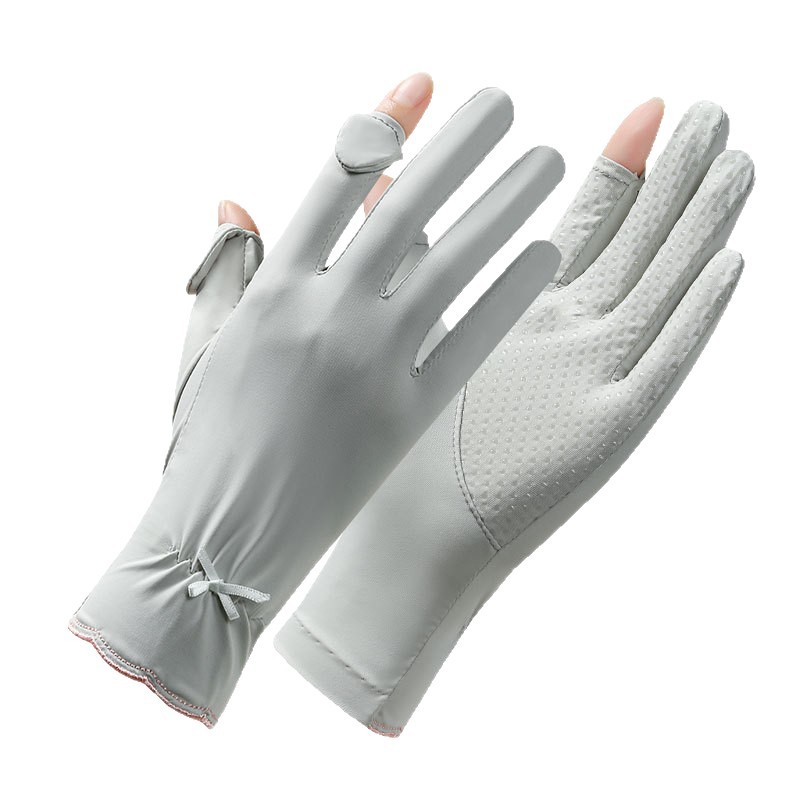
All suppliers claim UPF 50+, but the "how" is crucial. The picture reveals a specific wording: "阻隔紫外线" (UV Barrier). How do we achieve this?
There are two methods: Coating and Yarn-Integrated. Low-end manufacturers rely on Silver-coatings (powder coatings). These wash off after 5-10 cycles, dropping the UPF to below 20. High-quality summer gloves use Yarn-dyed UV absorbers—the ceramic/oxide particles are melted into the nylon chips before spinning.
· The Buying Guide Tip: For a functional glove, the UPF should be permanent. When inspecting samples, stretch the fabric. If the color lightens and the weave opens up significantly, the UV protection is compromised. The product shown uses an "原纱" (Original Yarn) process, meaning the UPF rating remains stable even under tension—a non-negotiable feature for active users like drivers and cyclists.
3. Tactile Tech: The "Full Palm" Silicone Debate
One of the most overlooked aspects of driving/cycling gloves is grip safety. Wet hands on a steering wheel or bike handle is a recipe for disaster.
· The Design: The product features "全掌硅胶防滑颗粒" (Full Palm Silicone Anti-Slip Particles) and "翻指设计" (Finger-Tip Flip Design).
· The Parameter Comparison:
· Standard A (Low-end): Small silicone dots on the palm. They wear out quickly and don't cover the pressure points of the palm.
· Standard B (Premium): Grid or wave-shaped silicone covering the full palm, as seen in this design.
· Ergonomics: Full palm coverage distributes pressure evenly, reducing hand fatigue during long drives. It also acts as a cushion, dampening road vibrations.
· The Touchscreen Flaw: Many gloves fail at the fingertip. Some use silver-coated fingertips that stop working after a week. This product features a "翻指设计" (Flip-open fingertip). While some might view this as a hassle, for B2B sourcing, this is actually a durability advantage. It allows the user to expose the bare finger for high-precision touchscreen use (facial recognition/typing) without ruining the glove’s conductive threads. It solves the "ghost touching" issue prevalent in cheap capacitive gloves.
4. The "Comfort Without Constraint" Paradox
The product description emphasizes "宽松版型,不紧绷,无束缚" (Loose fit, no tightness, no restriction) and "蝴蝶结腕口" (Bowknot cuff) .
Here is a common industry pitfall: Many buyers assume that "tighter" equals "better protection" (to prevent slipping). This is false. In summer gloves, compression leads to sweat accumulation and a "pasty" feeling.
· The Professional Standard: The "均码" (One Size) with a width of 8.5cm and length of 21.5cm is specifically calibrated to fit a wide demographic (Asian/European hand shapes) without constricting the carpal tunnel.
· The Cuff Logic: The elastic bowknot cuff serves a dual purpose: aesthetics and functionality. It prevents the glove from riding up when sweating. When evaluating samples, pay attention to the sewing thread. If the elastic isn't made of Lycra, it will lose its snap after 20 wears. We recommend checking the "弹力收口" (Elastic hem) for high-retraction memory.
5. Weight: The Overlooked KPI
The specification lists a weight of 40.5g ( ±0.5g) .
· Why this matters to your end-user: A heavy glove (over 50g) usually means a thick terry lining or heavy rubber silicone, which kills breathability.
· The Rule: For a summer unlined glove, the ideal weight range is 35g - 45g. At 40.5g, this glove sits in the "Goldilocks Zone"—light enough to be forgotten on the hand, but substantial enough to ensure the silicone particles have enough thickness to be durable. When sourcing, if the glove feels "heavy," check if the silicone is over-applied, which reduces flexibility.
Conclusion: Sourcing for the Smart Buyer
When you move past the beauty of the "Bowknot" design, this product is built on a foundation of solid textile science: Nylon ice silk for cooling, original-yarn UPF 50+ for permanent protection, full-palm silicone for safety, and lightweight construction for fatigue-free wear.
For you, the B2B buyer, your due diligence should focus on these 3 tests:
1. Stretch test: Does the white color become translucent? (Indicates low nylon density).
2. Silicone peel test: Rub the palm particles vigorously—do they flake?
3. Wash test: Wash it 10 times. Does the cooling effect vanish?
This glove passes these benchmarks. It isn't just an accessory; it is a piece of precision summer equipment. In your next sourcing meeting, use these parameters to separate the "fashion novelties" from the "functional staples." Because in the heat of summer, only the gloves that disappear on the skin are the ones your customers will repurchase. And that, ultimately, is the metric that secures the best ROI for your inventory.
Extended Cuff Gardening Gloves Buying Guide – How to Pick, Parameter Comparison & Common Mistakes
Complete Gardening Gloves Buying Guide – Choose Proper Protection & Avoid Common Mistakes