Kids Protective Latex Gloves: A Technical Deep Dive into Materials & Craftsmanship
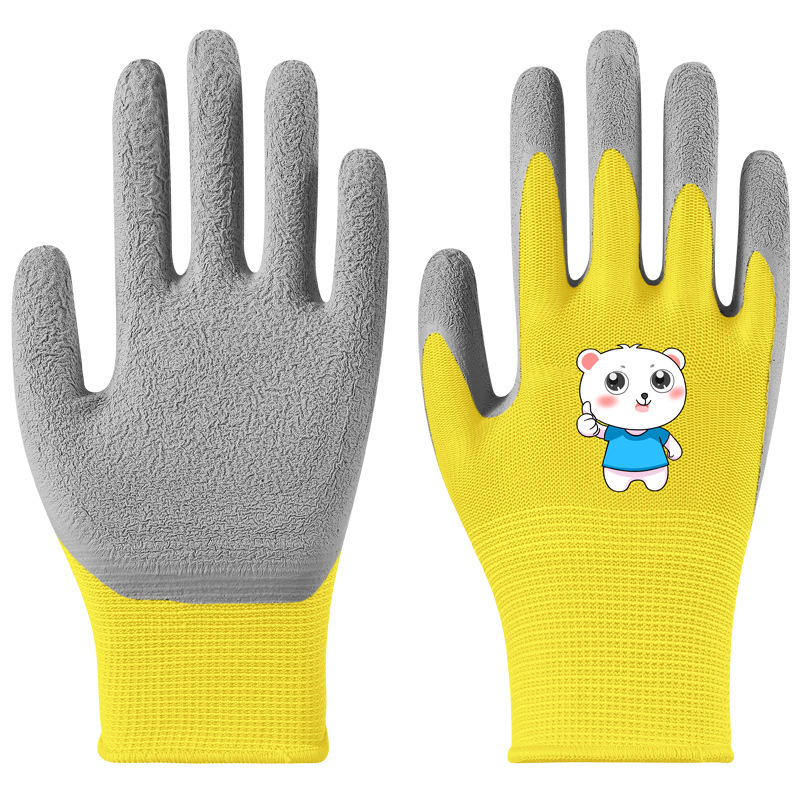
When children explore the outdoors—whether petting animals, building sandcastles, or tending to garden beds—their hands encounter hidden hazards: scratches, bites, abrasive surfaces, and irritating contact with rough debris. Our kids’ protective latex gloves are not simple miniature adult gloves; they are precision-engineered using specialized materials and manufacturing protocols that prioritize pediatric ergonomics, thermoregulation, and tactile dexterity. This guide dissects the glove’s material science, production processes, and industry terminology to clarify its technical superiority in the children’s PPE category.
Core Material Architecture: Breathable Substrate + Reinforced Latex Matrix
The glove employs a dual-layer composite system: a lightweight woven textile liner as the base, overlaid with a foamed latex palm coating. These two materials are industry standards for light-duty protective handwear, but our formulation optimizes each for juvenile physiology.
The liner is constructed from high-porosity polyester or nylon textile, selected for its intrinsic air permeability—a critical specification known in the trade as "breathable textile substrate." Unlike dense rubber gloves that trap perspiration and cause maceration, this woven substrate creates microscopic interstitial channels between fibers. These channels facilitate continuous evaporative cooling, maintaining the microclimate inside the glove at a comfortable relative humidity even during sustained wear. The industry quantifies this property via moisture vapor transmission rate (MVTR), and our substrate exceeds typical thresholds for children’s thermal comfort.
The primary protective element is the foamed latex coating applied to the palm and fingertips, technically termed "foam-dipped latex" in manufacturing specifications. The process begins with natural liquid latex concentrate, which is mechanically aerated with a foaming agent before dipping. This introduces a homogeneous dispersion of microscopic air cells throughout the cured rubber matrix. This cellular structure delivers two distinct functional advantages over solid latex films: first, the closed-cell foam acts as an energy-absorbing cushion, attenuating impact forces from sharp stones, shell edges, and pet claws through viscoelastic deformation; second, the micro-rough surface texture generated by the foam structure enhances dry and wet grip coefficient without increasing film thickness, preserving finger tactility. The cured layer exhibits high tensile strength and elongation at break, qualifying it as an "abrasion-resistant latex finish" per EN 388 standards, capable of withstanding repeated scraping against gravel, woody stems, and coarse coastal sands.
Manufacturing Processes and Ergonomic Engineering
1. High-Elastic Ribbed Cuff Technology
The wrist termination utilizes a high-elastic ribbed knit cuff, fabricated by interweaving spandex or elastane yarns into the textile edge. This construction generates uniform radial tension that conforms to a wide range of juvenile wrist circumferences—from approximately 12 to 16 cm. The elastic recovery ensures the cuff remains securely anchored during vigorous upper-limb motion, preventing the "glove migration" phenomenon where loose cuffs slide downward, exposing vulnerable skin. This feature is documented as "high-elastic cuffs" in product datasheets and meets the retention force requirements specified for children’s protective gloves.
2. Five-Finger Adhesive Forming
The entire glove is produced via a fully integrated five-finger molding process, known in manufacturing as "hand-shaped adhesive forming" or "form-dipping." During production, the textile liner is mounted onto child-specific aluminum hand forms (sized per anthropometric percentiles) prior to the latex dipping sequence. Each finger stall is dimensioned to match the natural taper and interphalangeal joint spacing of a child’s hand, ensuring that the dipped latex replicates the exact anatomical curvature. This eliminates the stiffness and webbing effects common in flat-sewn gloves, granting full metacarpophalangeal and interphalangeal freedom. Children can grasp small objects, manipulate pet toys, or dig with natural precision—a property the industry consolidates under "adhesive hand fit."
3. Segmented Partial-Dip Coating
The latex application is restricted exclusively to the palm, fingers, and thumb crotch—the zones of highest mechanical exposure—while the entire dorsal surface retains the bare breathable textile liner. This "partial dip coating" technique is a deliberate design choice: it concentrates protective reinforcement precisely where contact occurs, while the uncoated dorsum maximizes heat and moisture dissipation. Quantitatively, this reduces total material coverage to approximately 55–60% of the glove’s surface area, lowering thermal insulation and significantly reducing the risk of hyperhidrosis and thermal discomfort during extended outdoor sessions.
Industry Technical Specifications in Context
Several standardized metrics underpin the glove’s performance claims. The foamed latex coating achieves a Martindale abrasion resistance of Level 2–3 (per EN 388:2016), meaning it withstands 500–800 cycles of abrasive friction before breakthrough—sufficient for typical childhood play scenarios. The tear resistance of the coated palm registers at ≥10 Newtons, ensuring the film does not propagate rips from sharp punctures. Moreover, the natural latex formulation is processed with low-protein extraction and chlorination rinses to reduce residual allergenic protein content, aligning with pediatric dermatological safety guidelines (though individuals with known severe latex allergies should still exercise caution).
Application-Driven Functional Mapping
The material and process choices translate directly into real-world protective functions. For pet interactions—including cats, hamsters, and small dogs—the foam latex provides a resilient barrier against claw penetration and light bites, while the elastic cuff closes the entry point for stray scratches. For beach and tide-pool exploration, the abrasion-resistant foam withstands sharp mollusk shells and rough granite surfaces, delivering anti-cut and anti-puncture efficacy. In garden settings, the breathable back and flexible fingers allow unencumbered weeding and handling of soil, while the non-slip palm ensures secure grip on damp tools or stones.
Additionally, child-friendly cartoon patterns are applied via water-based screen-printing inks, which undergo adhesion testing (cross-hatch tape test) to ensure no peeling or flaking. The inks are phthalate-free and conform to EN 71-3 migration limits for toys, ensuring no dermal irritation even with prolonged skin contact.
Conclusive Technical Summary
In contrast to one-size adult heavy-duty work gloves, this children’s model recalibrates every facet of protective glove engineering—substrate selection, foam density, dipping coverage, cuff tension, and finger articulation—to match the unique dermatological and kinematic profile of young wearers. The breathable textile + foamed latex composite resolves the ventilation-impact trade-off; segmented partial dipping and five-finger forming optimize ergonomic fit; and the high-elastic cuff ensures mechanical security. Across pet handling, shoreline discovery, horticulture, and routine outdoor play, the glove delivers lightweight, all-purpose hand protection built on rigorous material science and process control—making it a professionally validated choice for parents seeking both safety and wearability in children’s daily adventures.
Silicone Heat Resistant Oven Gloves Complete Buying Guide
Dot PVC Anti-slip Work Gloves Buying Guide – How to Choose, Parameter Comparison & Common Mistakes